


In this episode, Ross Dunn interviewed Jason Barnard, the Brand SERP Guy, CEO and founder at Kalicube.pro. Jason’s understanding of how the Google Knowledge Panel can be influenced and leveraged for brand recognition is unmatched. SEO 101 listeners will takeaway very helpful tips on how to secure their own Knowledge Panel.
Noteworthy links from this episode:
- Jason Barnard, The Brand SERP Guy, CEO and founder of Kalicube
- What is the Knowledge Panel?
- Learn about Yoast’s Joost de Valk and Jono Alderson
- Learn about WordLift’s Andrea Volpini
- Learn more about Danny Goodwin from Search Engine Journal
- Moz’s founder and CEO Rand Fishkin
- Who is Bill Slawski?
Transcription of Episode 401
Ross: Hello and welcome to SEO 101 on WebmasterRadio.FM episode number 401. This is Ross Dunn, CEO of StepForth Web Marketing, and today we have a special guest episode for you. We’re interviewing Jason Barnard, The Brand SERP Guy, CEO and founder of Kalicube, and previously a blue cartoon dog—we will get to the bottom of that. How are you doing?
Jason: I’m doing great. As soon as anyone mentions the cartoon blue dog, I’m happy as a lark.
Ross: Good. Tell us a little about that. We’ve got to get to that, first off.
Jason: I was in a TV series where I played the role of a counting blue dog. She came from a website, so my initial work was on the web with my wife. She was a yellow koala and it’s all a little bit weird, but it did make sense when we made it, I promise you. And then, we made a TV series.
What was interesting and I say I’m glad it was a blue dog in a cartoon, which is nice, but we were in Mauritius in the Indian Ocean which is in the middle of nowhere, a small island, tropical island just off Madagascar. We had the blue dog and the yellow koala, and we were making five games and activities a month for the web. We invented families because we thought we can’t carry these two characters month after month after month for years and years and years.
We managed three years, and then we said let’s create a family. We created the family and the family didn’t say anything. Nothing for a year because we couldn’t get any voice talent to do the voices of the mothers and the fathers. My blue dog had a sister, a mother, and a father, and the yellow koala had a mother, a father, a grandfather, and a grandmother.
What we didn’t really think through was obviously we had to have these extra characters because nobody can build the series over 10 years with just 2 characters. You have to add other characters coming in. We couldn’t find a voice talent, so in the end I did five voices, more or less. I have to admit, some of them are pretty awful.
Ross: But they’re kids. Who cares? They don’t mind mine so that’s all right.
Jason: They’re my kids, actually. They know when you’re not being honest. You can get away with doing a voice that is incredibly convincing as long as the soul is there. I’m a great believer in soul, not in a religious sense but in a sense of who we are as people, as living beings.
The end of that story is I was my own mother, my own father, my daughter was my sister, my wife was my best friend. I was her father, our friend was her mother, I was her grandfather. That same best friend was both my wife as a grandparent and my wife as a parent, and that is bizarre.
Ross: Wow, that is not confusing.
Jason: Listen back actually make sense.
Ross: In a nutshell, how did you get from there into the web marketing space?
Jason: What happened was that I had a bad experience with a business partner. I was being a blue dog and I thought the world was made of roses, mushrooms, delightful peaches, and anything else it’s fluffy, delightful, and tasty. He was that ‘just make as much money as you possibly could, as quick as you possibly could.’
Unfortunately, he created a situation where he could take the business away from me and I lost the blue dog. That’s one of the greatest regrets of my life. I then had to rebuild the career. The first thing I could do was to say to people, the blue dog and the yellow koala site for kids, we were getting 5 million visits a month, 100 million page views a month in 2007 when there were not many people online.
A million of those came from Google, so I basically said if I can get a million visits for a site for kids on Google, then I can help your business get lots and lots of visitors because I can basically game the machine which, as we discussed earlier, was pretty stupid at the time.
Ross: Stupid, but as we know it works back then and we got here smarter about it.
Jason: That’s an interesting point, like looking back and saying how stupid was that, but at the time it was pretty complicated. At that time, Google was much better than the competition. Retrospect is a terrible beast because you look at it and you say, I was just counting words and counting inbound links. It seems so simple, but at the time it was phenomenally complicated.
Ross: It’s time-consuming, that’s for sure, and everyone else it was—like you’re saying—voodoo, and they have no idea. Even now, we have SEO 101 for a reason. We’re really just trying to demystify it all. It isn’t rocket science, but there are steps to it and it is a process. A lot of people don’t really have an understanding of that. I get it. I don’t know how to do the books, either, but I get someone else that does that. We all have our strengths.
Jason: It’s obviously incredibly oversimplified. In 1998—1997 you started before me. We had that discussion before and I’m terribly upset. You started a year before me—we just counted words. Google didn’t exist and all of these search engines—Excite, Lycos, Infoseek—just counted words. You would create one page per keyword per variant, and you ended up with thousands and thousands of pages to manage, each of which had a specific keyword density, and it would work. You could put white text on a white background and they couldn’t see it. You would just cheat your way through the whole system.
Then Google came along and said, let’s start counting links. This was a revolution and it changed the entire game. That was in 1998 when they incorporated, so 2000 when they started to really play the game as it were. You look at it now 20 years later and you go, that’s so simple. It’s so idiotically simple, but it was so even more simple before. You mentioned marketing, and you said in 1997 you were a marketer. I wasn’t; I was a word counter and a blue dog.
Then in 2015, we moved into this world where just counting words and links just doesn’t work anymore, and these machines are super smart. And we’re now moving into the world that I think you thought you were in 1997, marketing. If we’re not a good marketer, we’re not going to live.
I see how Google, Bing, Yahoo, Apple, Facebook, Twitter, all of these machines work in the same manner. They understand the world. They have Knowledge Graphs that understand the world in a similar manner as a human being. You have to convince it like you have to convince a human being.
Ross: Yeah, you do, and I love that with Google these days. We should say these days. We’ve been doing this for a long time simply because (I guess) it wasn’t so much I saw the light; it was so much as I wanted to sleep at night. They didn’t want to do any of the stuff that might get your rankings right away but really would get you a bit later.
We just went with the “white hat.” It’s a hard thing just to put on paper, but we just didn’t do anything that went against the guidelines for many years now and just built up clients through great content, ensuring their site was well-indexed, and just really following the rules. Doing any link building is not following the rules, so there’s that gray area. The fact is, that is part of the algorithm and people need to get things faster, but that’s it.
Jason: A couple things. Number one is I agree with you 100%. I didn’t venture into the black hat, white text on white background world. I didn’t need to because the content was great quality. We got engagement from the beginning. In fact, I would agree with you that we were marketers from the get-go. The kids love the games, the kids hang around the games, the teachers, the parents, the grandparents, and the babysitters all love the site, so we got that kind of traction in the visits.
The other thing is the inbound links. I didn’t create a situation where I get the links and put to get a link. What I did was simply suggest to people they might want to link to me, which isn’t the same thing. So I don’t think link building per se is a bad thing. It’s simply that if you suggest it, some do think that’s a good idea. That’s fair game.
If you say to them, you give me a link and I will give you something in return, or you give me a link and you get something in return from whatever means, that’s link building and they are getting into the gray area. But if you’re just saying, hey why not put a link because X is actually really useful to your audience, the teacher [00:09:50] for example.
Ross: That’s just good networking.
Jason: Exactly. That’s good marketing and that’s fair dues. It’s always been fair dues.
Ross: Fair enough, and I think it’s been a fun ride. We could go on forever about all this stuff. It’s been a few years hasn’t there? A few changes, just a few. I came to know about you, about what’s from Kalicube, but that was through the Knowledge Panels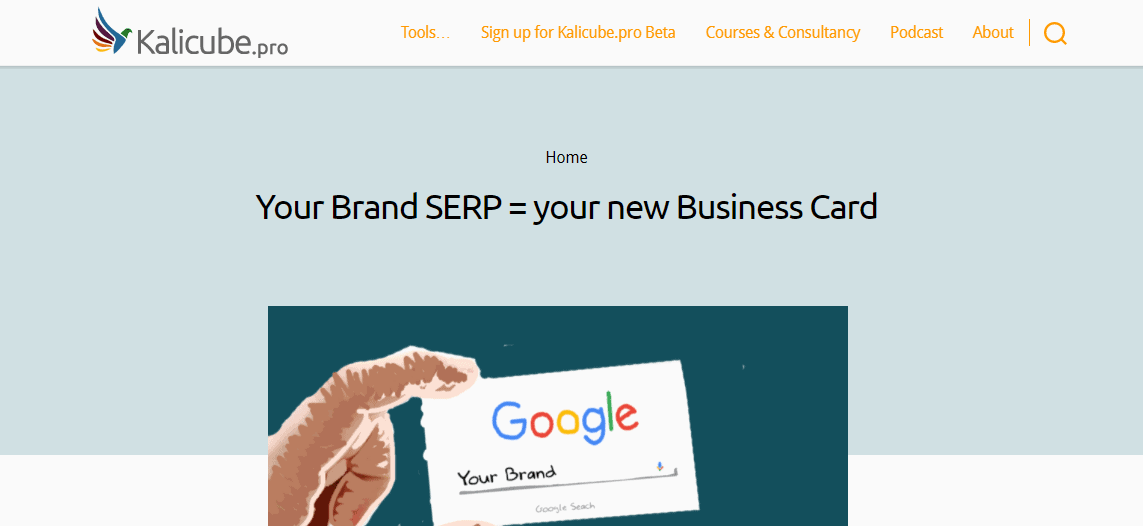 .
.
Jason: Yeah. I’ve gone a bit mad there, to be honest. I think I’m one of the only people working in a terribly granular manner. There are lots of tools that will build this semantic network and Knowledge Graph.
Ross: The average listener probably won’t have a clue what we’re talking about, so what is it they call what you’re into? What is it you do with the Knowledge Panel?
Jason: I started out and it actually comes from the blue dog. I’ll tell you the story as quickly as I possibly can because that’s phenomenally interesting is when the blue dog company collapsed in a heap, and my partner walked away with the company and the blue dog, which, between you and me and anybody who’s listening, it literally ripped out my soul. I felt like my entire existence as a being on this earth had gone.
I was so much that, but I’ve got so much into being a blue dog because it’s loads of fun. I ended up thinking I was the blue dog. When he took the company away, it felt like he had ripped my soul out my body. I had to rebuild, so which was, at best, kind of one of these philosophical things I managed to do and I’m very happy about.
What I had to do is I actually make a living in the short-term. Making a living was going out and saying to people, I can build you SEO. I can do what I did with the blue dog and the yellow koala. I realize that I was actually going into the meetings. People would say, yes we want to work with you, this is great, this is going to work out, and I thought, sale. Literally, I was thinking like 90% of the time asking, and that’s a sale that’s done. Fifty percent of the time, they would pull-out; they wouldn’t sign the bill.
Somebody told me, actually, what we did when you walked out of the room was we looked up your name. We googled your name and it just shows a blue dog. The blue dog is the cartoon and we don’t want to entrust our entire digital marketing strategy to a blue dog, so we didn’t sign the contract.
I realized at that point that my business card wasn’t what I handed to them in the meeting—well, obviously is. My most important business card is that double-check they do afterwards, which is searching my name. I then set about saying, okay, obviously, the blue dog is part of my life. It’s not going to just pay for my personal brand SERP, what appears when you search my name. What I can do is make sure that the dominant information is I’m a digital marketer, I’m credible, I’m authoritative, I’m trustworthy, and I’m an expert which is EAT—expertise, authoritativeness, and trustworthiness that Google talks about all the time.
I used the same name 2015 and it worked a treat. All of a sudden, the meetings went well and then I would sign a contract. Afterwards, there were no problems at all. It made me realize how incredibly important it is that we control what Google shows when somebody searches our personal name or our brand name. It completely changed my points of view of what I was trying to do.
Knowledge Panels are obviously a part of that. Knowledge Panels are a representation of Google’s understanding of the entity, the person, the brand, the music group, the song, the movie, whatever it might be. It shows in that right hand side as fact. We look at that as human beings and I think we don’t really realize that as we look at the left-hand-side, it’s all advice, its recommendations. This is what Google thinks is possibly the best result for what you’re looking for.
On the right-hand-side is saying this is fact, so once you get that Knowledge Panel which is the next step beyond the brand’s SERP, are you saying I’m a digital marketer, that Knowledge Panel is Google saying this is what Jason Barnard is. And it isn’t Jason Barnard is a blue dog—obviously, that’s a problem—it is that Jason Barnard is a digital marketer and he’s incredibly impressive, but he was a blue dog once in the past. Absolutely no problem at all.
What I’ve now started to do is I need to manage two things. I need to manage the brand’s SERP which is the big thing. The result when somebody searches your brand name. The people who search your brand name are your audience, so the most important people to your business or to yourself as a human being. By looking you up or they’re navigating to your site, they’re interested in you, that people are close to either doing business with you or are already doing business with you.
Then on my right-hand-side, you’re looking at what Google perceives to be facts about you. That’s getting really deep into the brain of Google, which is what we were talking about earlier is that Google’s trying to understand the world like a human being does. That Knowledge Panel on the right-hand-side is exactly the representation of what Google has understood and it’s confident it’s understood.
Ross: Awesome. Let’s take a quick break. When we come back, let’s unpack this a bit and figure out how a person can do that. We’ll be right back.
Welcome back to SEO 101 on WebmasterRadio.FM, hosted by myself, Ross Dunn, CEO of StepForth Web Marketing, Inc. We’re joined by Jason Barnard, The Brand SERP Guy, CEO, and Founder of Kalicube.
Jason, let’s say the average person out there has the interest of having their own Knowledge Panel. They want to be able to say, you can type in my name and I’m going to show up in a Knowledge Panel. This is what I do. Is that possible for the average person?
Jason: Yes, but not for everybody. It’s a great question because a lot of people think, I see Wikipedia in there so I have to be famous, I have a Knowledge Panel. That’s simply not true. Obviously, people who are famous are going to have a Wikipedia page—Wikipedia remains dominant—but Google doesn’t have the concept of notability that Wikipedia does.
Wikipedia and Wikidata (for that matter) will say, you need to be notable, you need to be interesting to other people. People will search for you spontaneously, so we will not put you in because we don’t want for Wikipedia and Wikidata with junk data about useless information that people are simply not interested in. It is not to say that you’re not important. It simply says that people—as a general volume of entities—aren’t interested in you, specifically, so you have that level of notability you need to have.
Whereas, Google is simply saying, I want to understand. It doesn’t have the filter of saying you need to be notable. It just says, I need to understand.
Ross: Not quite as snobbish.
Jason: I was going to say that, but I’m going to get in trouble with Wikipedia editors again.
Ross: I can say it.
Jason: You’ve got that question, one of which is Google as understood who you are. The second question behind that is what is the probability that a person is actually searching for you, Google users searching for you and not somebody else or a brand with the same name.
Ross: That’s the kicker I find, but yes, we’ll get into that.
Jason: You can have a Knowledge Panel, but you don’t necessarily see it in the search results. The Knowledge Panel is there; it’s just hidden. Google never shows it because it doesn’t think that the probability that somebody searching for you is still very high. That depends on multiple things, one of which is the commonality of your name, the ambiguity of your name. A few called Simon Cox, friend of mine, loads of people named Simon Cox. Obviously, that’s ambiguous. It never knows which one you’re actually looking for, so has a lot of trouble with that one.
Secondly is how newsworthy you are. Now the idea of notability does come in. If you are more notable, that Knowledge Panel will be more likely to appear. But then, you are in geolocation. I found the example of Mary Moore. I can’t remember when I found that name, but Mary Moore in America is the actress Mary Tyler Moore, plus a writer, plus there are six or seven Mary Moores in America. In Ireland it’s a writer, but it’s a different writer; in the UK it’s an actress, but it’s a different actress; and in Australia, it’s a judge.
In fact, if you search for that name Mary Moore in these five different countries, that is what Kalicube does. It tracks it across these, in fact, six countries. It shows you that geolocation, especially for human beings, people’s names is phenomenally important to the probability that you’re searching for them. If you want America, Mary Tyler Moore is probably the big one. If you’re in Australia, apparently Mary Moore the judge is incredibly newsworthy, [00:19:28], and interesting. The probability, and it’s nothing to do with am I famous or am I’m not famous, am I important or am I not important, am I—
Ross: It’s the relevance.
Jason: It’s the relevancy to the geolocation. Potentially, as we move forward with things like Google discover which we will then unpack, I’m sure the relevancy to me as a user.
Ross: Interesting. Let’s take me, for example. Obviously, I’m well familiar with my circumstances. There’s a lovely man by the name of Ross E. Dunn, and he’s an author. I find that very difficult to get anywhere with. If I try to get into top ranking, there’s just no way because he’s got a Wikipedia article. I’m finding that’s a stop issue.
Correct me if I’m wrong in any of this stuff, but it seems like that’s just getting past that. If I try to get Ross Dunn, it doesn’t seem to happen. Another is a footballer—dammit—that’s a Ross Dunn that’s doing lots of…
Jason: Who’s taking in millions of dollars.
Ross: Yeah. If I type in ‘Ross Dunn SEO,’ I would have thought I would show up for sure because there is no other, but it doesn’t happen. Again, my example if you want, but what does a person need to do to have that work?
Jason: There are multiple points, in fact, in what you’ve just said. Ross Dunn the writer is perhaps interesting, famous, or more probable in the US but not in Australia. There’s probably a Ross Dunn in Australia who’s beating the pants off your Ross Dunn there because they’re more relevant to the users in Australia. Immediately, you can say that part of the problem has gone. It’s not simply that he’s more famous. It’s that he’s more relevant within the context.
I’m going to use my name because I haven’t researched your name and I do apologize for the completely lax preparation for the interview.
Ross: That’s all right. I’m not going to publish this episode. Anyway…
Jason: If you look up Jason Barnard, there’s a footballer in South Africa who’s quite famous. There’s an ice hockey player in Canada. There’s a doctor in New York somewhere. There are three digital marketers in the UK. It’s not like I don’t have any competition, but if you search my name I come up in all of these places. Number one, number two, number three, number four Each of these people get one blue link and I get the Knowledge Panel, the video boxes, the Twitter boxes. I dominate, and that’s sitting with confidence.
Google is so confident that it knows who I am, what I do, that it just throws that out there simply because it’s thinking at least I know this is true. So you’ve got that aspect of it, but then if you go to San Francisco—I recently discovered there’s a university lecturer called Jason Barnard in San Francisco who’s published multiple papers—there, all of a sudden you don’t get the Knowledge Panel. He gets a couple of places as opposed to just the one, but on the right hand side you no longer see my Knowledge Panel, because then Google is saying, which one do you mean? Do you mean the one we’re really comfortable about, who keeps going on about himself, Jason Barnard the digital marketer, or do you mean the university lecturer who happens to be at the same time as you in San Francisco?
You have those multiple aspects which are probability, confidence, clarity, that Google has understood who you are, what you do. It’s like a child in many aspects. We need to educate it, and like a child you need to educate it bit by bit, point by point, through trusted sources such as the headmaster, the parents, the grandparents, whatever that might be for a child. Secondly, it doesn’t want to say something that might not be true. It doesn’t want to make a fool of itself. That kind of confidence is like this child pitching up and going, I know this.
If you think about Google, of the child in the Knowledge Graph sense and how it understands the world, you need to educate it, you need to make it confident so it can leap into the party atmosphere and shout out what it thinks it’s understood.
Ross: Is there a way to explain how that is done to the average listener without showing up?
Jason: It’s actually incredibly stupidly simple. I mean it really isn’t complicated. Kalicube.pro, I built the platform. Basically, what I’ve done is I’ve figured out how to educate Google. The process is incredibly granular and incredibly boring. It’s very time-consuming and I can’t think of anything less interesting than my actual job in that sense.
What I did was built Kalicube.pro as a platform that automates everything that I’ve figured out what to do. I initially developed it because I was so bored in my own job. I thought I have to figure out a way to make this easier for myself, and bit-by-bit I built the platform.
Basically, what it does is it pings Google about an entity—yourself, myself, a company, your company, Kalicube. I work with Yoast the plugin with Joost de Valk, Jono Alderson. Hopefully, I’m going to be soon to be working with Wix, looking forward to that one. I’m working with SE Ranking, working with WordLift. I’m name-dropping here but—
Ross: Yeah, you did a great job. That’s awesome.
Jason: Seriously intelligent marketing people representing seriously important companies in the world, who realize that making sure that Google not only understands who you are, what you do, and who your audience is, but it is incredibly confident in that understanding, is the fundamental basis of everything that’s going to come, and if we start now we’re going to win the game.
What Kalicube.pro does and all of these clients are basically saying, theoretically because I know my business, because I’m an SEO, I could do all this because all it involves is saying my website is the entity home. Google looks at that and it says, that’s the horse’s mouth. That’s the information I get from the horse’s mouth. Fair enough, just don’t believe you because the horse doesn’t speak the truth, necessarily. Horses lie. Sorry horses and horse fans. I do apologize by the analogy.
Ross: Victimized.
Jason: Yup. What you do from the horse’s mouth is point to all the corroboration. This is basically saying, the child was heard from a parent, but if they get confirmation from the headmaster, the postman, the policewoman down the road, all these people that the child trusts, the grandparents—grandparents are great, love grandparents—if the child gets confirmation from all these different sources, it becomes confident that it is fully understood.
Ross: And that’s the sameAs Schema.
Jason: Exactly. Basically, you say on your site, as the horse, what it is you want Google to understand, who you are, what you do, and who your audience is. Which of the three single things needs to understand in order to be able to begin to consider you as a solution for its users. Then you say, look at all this corroborative information. Then you just go around the Internet and correct or make sure that it corroborates what you said on your site, which is ridiculously simple and very stupid. That’s how it works.
Ross: And time-consuming, like you said.
Jason: Yeah, and boring, and figuring out which is the most important source. Who knows? Wikipedia and Wikidata, obviously. That goes without saying. For any industry and any geolocation, the most important source is going to be different. But beyond that, any individual company, person, music group, music song, product, it doesn’t matter. The actual list of important sources that Google is paying attention to is different.
I hadn’t realized quite how different until I built the tool and tested it on my own name. I’ve been working on this for seven years, so I know all the sources that talk about me. I’ve got this terribly tentacular and depressing grasp on the whole thing, which seems terribly self-centered, but it’s actually just I want to understand what happens when I change things.
The system I built pulled up 10% of the references that I thought were important, that turned out not to be important, and vice-versa. If I’ve been doing this for seven years, I’ve really been paying attention, and the machine pulls up 10% where I was actually wrong, I went wow, yeah, okay. Now I think about it, that is true.
What I’ve done is basically said, the machine Kalicube.pro pulls out a list and says this-this-this-this-this-this-this in this order. Go and correct all that information, create your home, point to it, Bob’s your uncle, bingo, and you’re in there. It’s blindingly simple. All I’m doing for people like Yoast, SE Ranking, and WordLift is offering them a big, big time-saving operation where they could do it themselves, but I saved them loads of time.
Ross: You’re filling a phenomenal gap, obviously, because I didn’t know much about this until I started reading about it. Again, I was drawn to your site and I’m like, this guy knows what he’s talking about, and it’s been great. You’re popping up everywhere now. Good for you.
Jason: Yeah, I shout very loud. I mean I’m part of it. I just like talking. Sorry, I do apologize. Being British I feel terribly guilty about the fact, but an awful lot of what you see is me experimenting to see what happens when I change something.
An interesting site is Wikipedia, where I had Wikipedia pay for myself. I had one for the blue dog and yellow koala. I had one for my punk folk group from the nineties, all of which are notable. Absolutely no question at all that they’re notable. They all got deleted last year. They all got deleted because I’ve been messing with them too much.
Why had I been messing with them too much? Obviously, I wanted it to be correct, but also I wanted to see every time I change something—I did it several times; I’m terribly naughty and I’m sure the Wikipedia people don’t like me—I change the stuff to see what the Knowledge Graph would do in response. At the end of the day, what I did was learn. Somebody came along and said, you’ve been messing with your Wikipedia page; we deleted it. They all got deleted within two weeks.
Ross: It is pretty ridiculous, though. If they’re notable, they should be there whether or not they’re opinionated or not.
Jason: Wikipedia actually has two rules. One of them is notability and the other is you shouldn’t be editing your own article. They deleted me on the second one. It’s [00:31:14]. I don’t necessarily agree. I think the notability thing should have come to that particular point, but fair enough.
It actually comes down for three days I sulked. My ego took the biggest hit. Then I thought, actually, Wikipedia is not the people to judge whether or not what I have achieved in my life is important or not. Then I thought, how can I now prove to Google that what I had been saying on Wikipedia—I do say, I had been saying on Wikipedia—is in fact true, and rebuilt all three of them.
I did an interview with Rand Fishkin about a month later. It was really interesting because he said he fought to have his Wikipedia page deleted. I said why and he said because they were saying things about Moz, who founded it, where it will work, how much money was put into it. It was wrong. The information was factually wrong and I tried to correct it. They wouldn’t let me correct it because I am the person concerned, therefore I’m not allowed to get involved. That’s where you get into this terrible debate and it’s a terrible cycle.
He got it deleted. He said, actually the reason I looked or I tried to get it deleted, I ended up getting it deleted was because I don’t want Wikipedia editors to control my brand story, my personal story. As soon as he said that, I was certain that his list was literally a month after all mine had been deleted and I’ve been sulking. I said, you understood intellectually what I had to understand by getting slammed, basically. I had to learn a difficult lesson and he had figured out with himself from a logical and an intelligent point of view.
Absolutely hats off to Rand Fishkin for that because you don’t want these faceless Wikipedia editors controlling your brand story or your brand message. Wikidata is perhaps slightly different, but you want to control it yourself. That’s the fundamental basis of Kalicube. I want you to control your own message because I know that it’s possible, I know it isn’t actually very difficult. It’s just really boring and really long.
Ross: Turning this into an SEO-related thing, does this have any impact on SEO?
Jason: Yes. Number one, anybody who searches your brand name is your number one top favorite person because they are either about to do business with you or they’re doing business with you already, so that’s obviously very important.
John Mueller near the end of last year at SMX said, brands need to be aiming at pool queries. What he means by pool queries is branded queries. They call them pool queries and basically Google are now saying you actually want people to be searching your brand name.
I think from an SEO perspective that’s fairly obvious why it shows that you’re popular, it shows that people like you, especially when your brand name is associated with positive terms like Jason Barnard. Genius. Best try that one on. I try to encourage people so that I suddenly look intelligent to Google.
Number one is the brand search. Number two is what appears when somebody searches your brand name. But number three, if you search for best podcasts, you see a big carousel at the top. That’s above the blue links, it’s above those normal results. I would [00:35:00] Seth Rogan and famous people. There’s no reason that you or I couldn’t be in there, especially if it’s best SEO podcast. You get a carousel for that, too. That’s all based on entities. It’s based on Google’s understanding.
Once again going back to that child analogy, if Google understands that your thing is a podcast, where it can send you usefully so you can listen to that podcast and understands that’s what you’re looking for, Bob’s your uncle. These are the rich results. The blue links aren’t necessarily dead, but certainly these carousels, the video boxes, the Knowledge Panels, the people also ask all of this is increasingly based on Google’s understanding of the world, is entity-based search when we were talking Dave Davies earlier on. Read a couple of articles by Dave Davies and you’ll see exactly what I mean.
Ross: That’s awesome; there’s a lot of work to it. Kalicube, why don’t you tell everyone so they can find it?
Jason: The platform is called Kalicube.pro. Kalicube is actually an agency that I created years ago. It started collecting all this data about 78,000 brands and people, in a database with 10 million brand SERPs. I’ve got a database full of Knowledge Graph information; it’s completely insane. I’ve been collecting it for years thinking this is going to be useful one day, one of those hoarders. It’s all sitting in this database somewhere. All of a sudden, it’s become interesting and become useful.
I’m talking to people like Bill Slawski (Go Fish Media) [00:36:42] in the SEO world, or [00:36:44] from Wix, or Andrea Volpini from WordLift. I realize how important this database is going to be because I’ve got three or four years of data for Google’s understanding of entities of things in an understanding the world sense. I’m incredibly excited about it. All this hoarding is finally coming to fruition and it’s going to be useful to the community and not just for me.
Kalicube is actually a free set of tools that you can just go in and look at what’s in a Knowledge Graph. You can note what the trusted sources are, all of those are free. The page aspect of Kalicube is simply to say, I’m just going to make this really easy for you.
Ross: It’s Kalicube.pro, right?
Jason: Yeah.
Ross: Okay, so not .com, everyone, it’s .pro. It is great, It’s got lots of phenomenal content on there, lots of reading. You’ve got a course you teach, right?
Jason: Yeah, I’ve got courses too, but actually, the .com, I actually recently bought it because it was available four years ago and they were asking for $6000 for it. I said I’m not buying that $6000. The price has just gone down. As long as I held out and didn’t buy, the price came down.
It eventually came down to a price that I will not name. It seem to be reasonable not from the point of view that I really thought it was useful, but I now want to see if I can switch the entire Kalicube.pro website—which is all about the podcast, the events, and the free tools—to Kalicube.com and have the Kalicube.pro website as the platform for helping you with what the Kalicube.com website explains to you, and see if I can make that switch seamlessly, that when you’re searching Kalicube, it never skips a beat in terms of what actually appears, that Google understands the switch. That’s my challenge for the month of April.
I’m not getting overexcited, but that’s what it all comes down to. My entire existence is about experimenting on things that I control. I don’t want to experiment on clients. I want to experiment on me because if I get it wrong it doesn’t matter. You got the blue dog and the yellow koala. They’re families. All of those are in the Knowledge Graph. The songs, the albums, my music group, my company, myself.
The idea from my perspective is the more I experiment, the more I learn. The more I learn, the more I can share. The more I learn, the more I can help people with problems that they can potentially have. I’ve probably seen most of the problems that people have had simply because I’ve got it wrong so often over the last seven years. I now know when not to stick your feet.
Ross: That’s awesome. I tell you, I’m always watching, there are always lots to learn, and it’s not an area that I have time to keep on top of. It is just like anything else. It takes a lot of time. SEO used to be something that you could just digest yourself. You could spend the time. It wasn’t that difficult. It’s not so much that it’s difficult now, but it just got so much minutiae that you’ve got to focus. Congratulations on picking a really good niche.
Jason: I think that’s really true. The interesting point is I have an awful lot of trouble not getting distracted by other things I think are really interesting. Somebody says, those update. I was talking to Glenn Gabe on Twitter. He was saying, I’ve written this amazing arc about the Google update in December, and I was going…
The thing about brand SERPs is that the Google algorithm updates don’t affect me very much. Actually, I don’t care about Google updates in my little world of brand SERPs. It’s so tempting to go and look at it, but if I do I get lost in a rabbit hole that actually doesn’t help me.
I noticed the other day I’m doing some data studies and it seems to me—this is not yet confirmed—that when the Google algorithm, the main algorithm is very active December last year, January this year, the Knowledge Graph doesn’t change. The Knowledge Graph just had a big update 11th of February, on my sensor systems that I’ve got in Kalicube—you can go and have a look at—and it’s basically once Google main algorithm settles down the Knowledge Graph can play around. They don’t mess with both at the same time. This is a big enough rabbit hole for anybody.
Ross: I see it for some reason that all assumptions, but I assume that the Knowledge Graph was a constant iteration, didn’t get big updates.
Jason: 100%. That’s what all think and that’s what I thought. Then I noticed a year-and-a-half ago in July and August of 2019, there was a massive update. Absolutely massive. I wrote an article in Search Engine Journal and I do encourage you to read it. I tweeted about it the other day and I literally cried the morning I finished the article because I thought I just found something that nobody else has thought about or seen, and I was so wow; I’m a bit of an emotional chap.
A year-and-a-half later I just reanalyzed the data from the last year-and-a-half. I realized there were updates a couple of times a month to the Knowledge Graph. Interesting enough, it takes December off. The last two years it hasn’t done anything in December, so December is kind of a holiday for the Knowledge Graph. It would seem to me—I’m still investigating it—that the Knowledge Graph updates and the Google updates are basically happening in an off sync manner.
Ross: That’s really interesting; opposing schedule.
Jason: That’s my new theory. I don’t know if it’s true, so I’m throwing it out there and it might be completely wrong, but this is my theory.
Ross: If people want to keep track of this kind of work you’re doing, do you publish your findings as you go or is this all just behind the scenes? Is there a place we can follow to read about this as you’re doing it?
Jason: It’s a mixture. If I don’t publish information I have figured out, it’s simply I don’t have the time and it’s nothing to do with me trying to hide stuff from [00:43:19] Kalicube because that really isn’t my bag. What I realize is that if I explain everything to everybody, the value of Kalicube is simply that I’m going to save you loads of time, and if I didn’t do that I’m winning the game and all the way down the line.
There’s nothing very complicated per se. You have to state on your own site who you are, what you, who your audience is, and then get it corroborated by all sorts of trustworthy sources. That’s bleeding obvious once I said that. The trick then is to figure out which of the sources and how to actually present yourself on your own site, which is more complicated than people think. Your language, the way you describe yourself in your own site is often very ambiguous. I don’t want to be rude to marketers, but a bit of fact wouldn’t hurt anybody. You’ve got that whole point.
My research is not about keeping secrets. It’s about saying if I can get people to understand what it is we’re faced with, I’m much more likely to get them on board, for me to help them to make that task as simple, as fast, and as painless as possible.
Search on Danny Goodwin from Search Engine Journal. He’s incredibly supportive. He will publish any of my kind of mad theoretical ideas, and I love him for it. I published a lot there. I published a lot on WordLift. I don’t publish on my own site, so if you want to read what I’ve been writing, have a look on LinkedIn or Twitter and search my name. It all comes up Search Engine Journal, Search Engine Land, WordLift, SE Ranking is starting to publish some stuff. SEMrush has published loads of stuff. It’s distributed and we have to follow the breadcrumb trail. I’m actually now thinking of setting up a page on my site to just list them all to make it simpler.
Ross: There you go. It’s going to be a long list soon, right? It’s as good.
Jason: Yes. The other thing, just to close this whole aspect, is I’m sharing the information. I think showing myself to be reasonably expert, authoritative, and trustworthy within my domain, and that’s a big part of SEO today. If my own site I can succinctly indicate to Google this is where all my corroborative, authoritative, expert, trustworthy content is being published—Search Engine Journal, Search Engine Land, WordLift, so on and so forth—I think that’s going to build Google’s confidence in my own EAT. I have no proof, I’m in the process of testing it, I’m going to [00:46:13] and in five or six months I think I will have some kind of indication that this is a good practice and it’s a good way to move forward.
Ross: Wonderful. On behalf of myself, Ross Dunn, CEO of StepForth Web Marketing, and my special guest, Jason Bardard, The Brand SERP Guy, CEO and founder of Kalicube, thanks for joining us today. Jason, you’ve just been an amazing guest. Thank you. I really appreciate [00:46:39] podcast today. Very done, so you fit in and I appreciate that.
Jason: I love it and I appreciate the fact that you let me rant, rave, and gabble on. I loved it. You said it was going to be cool and easy-going, and it was.
Ross: Excellent, glad to hear it. Remember everyone, we have a show notes newsletter you can sign up for at seo101radio.com. There you don’t miss a single link, you can watch the video from this, and we’ve got the full transcription as well with links.
If you have any questions you’d like to share with us, please feel free to post them on our Facebook group, easily found by searching SEO 101 Podcast on Facebook. If you enjoyed the show, we’d appreciate any feedback on Apple Podcasts, Stitcher, or your favorite podcast stream. Have a great week and remember to tune in to future episodes which air every week on WebmasterRadio.FM.
Jason: Brilliant.